

Frankensteined Chanel Exotics on the Rise
Finding a near-pristine vintage Chanel exotic handbag is a pinch-me moment for most collectors. That’s because, more often than not, stumbling on a find of that caliber is too good to be true. And given the recent events unfolding in the luxury market, it very well may be.
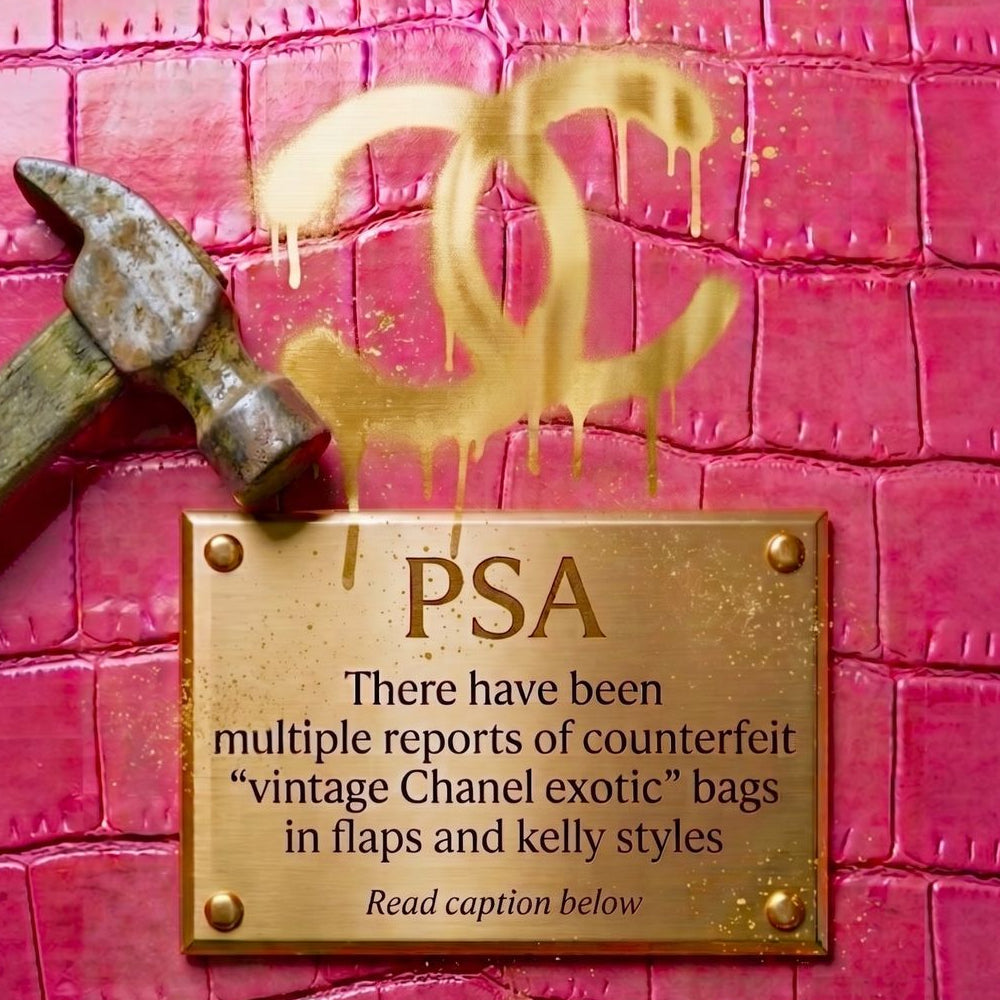
There has been mass production of Frankensteined 1980s to 1990s Chanel exotics originating from a factory in China. At least 30 vintage Chanel Classic Flaps and Chanel Kellys have been “Frankensteined” and resold to collectors, dealers, and resellers since May 2026. These Frankenfakes customize suede, leather, and canvas Chanel bags with a porosus crocodile exterior and sell them for $20K to $100K.
In the world of vintage, refreshing your bag is not new. Keeping a clean bag is key to keeping it alive. This act, however, is not a simple refresh that injects life back into an old favorite. This version is entirely deceptive and an outright scam.
From Dream Bag to Nightmare
What exactly was the intense appeal of these Frankenfakes? For starters, Chanel ended the use of exotic materials in 2018, making vintage versions extremely rare and extremely collectible. In addition to exotic skins, old-school Chanel bags used higher-quality materials (like 24K gold-plated hardware) and rigorous levels of craftsmanship.
When Croc Chanel Kellys and Jumbo Classic Flaps in like-new condition hit the market recently, collectors thought they had struck gold, especially as many of these pieces were being sold by reputable and non-reputable platforms alike. And the most horrific part is that they were able to bypass the AI authentication, leading resellers and collectors alike to believe they landed on the real deal.
But How Did This All Unravel?
There were, of course, holes in this Chanel scandal, but not enough to set off the alarm for AI authentication detectors (more on this later). But one of the biggest holes was the porosus crocodile exterior. Chanel never made the Chanel Kelly in porosus crocodile. The style in question was always manufactured using alligator. There were other tell-tale signs, of course, including the placement of the croc and, most importantly, the ambiguous serial numbers.
This was not the first time Chanel serial numbers were used in a mass hoax. In October 2012, a heist at a Chanel-contracted factory in Milan resulted in the theft of 30,000 genuine authenticity cards and hologram stickers. The stolen serial numbers fell precisely between 17,686,401 and 17,716,400. Because these authentic labels were later affixed to high-end counterfeits, any secondhand bag bearing a serial number in the 176 to 177 range immediately became a fraudulent red flag for luxury authenticators.
What Exactly Is a “Frankenfake”?
We consider a 'Frankenstein' piece to be any bag that combines authentic components with non-original ones; it's not a straightforward fake, it's a hybrid, and that's what makes it more dangerous and more sophisticated to detect. One example is a bag where the shell, the actual body, the exterior leather, and the construction are genuine; however, at some point the lining was replaced with another era's lining. These pieces are tricky because every individual component can pass certain checks in isolation—the leather is real, the stitching pattern on the body is period-correct, but the bag as a whole is no longer an authentic representation of what the brand produced.
Whenever we identify that any part of the bag has been compromised, we err on the side of caution and reject the piece entirely. This standard protects both the client and the integrity of what we're representing when we authenticate something.
Identifying Frankenfakes
Authenticating exotic vintage or any bag requires a comprehensive approach; we never rely on a single data point like a designer ID or hardware engraving. We have to evaluate the entire piece holistically, and that's exactly why human expertise is irreplaceable in this process.
We start by examining the materials themselves: is this genuinely the exotic skin it claims to be, and does the stitching match what we'd expect for that style and production period? Every era has construction signatures, and vintage houses didn't always build things the way they do today.
Next, we cross-reference style and leather or hardware combination: was this particular bag ever actually produced in this material during this period? Brands didn't offer every skin on every style in every era, so that combination itself can either confirm or immediately flag a piece.
We also scrutinize the metal components: is the hardware consistent with what that brand was producing in that specific production year? Plating, engraving depth, even the alloy finish can shift over decades.
Designer ID and serial numbers are important, but they're not proof on their own. An authentic ID can still be paired with a style it was never issued for, so we ask whether this style was ever made in this ID series, and we look closely at placement, spacing, and stamping depth to see if it's been tampered with or swapped.
With vintage exotics specifically, age itself becomes part of the evaluation. Exotic leather develops character over time; even a bag that was barely worn will show thirty-plus years of natural aging in the grain, the patina, the way the skin has settled. That aging pattern is authentic wear, and it's actually part of what makes vintage pieces beautiful. A counterfeit can't replicate decades of real material aging.
What ties all of this together is that ultra-luxury brands all use high-quality materials that are essentially signatures of their identity. Our job as authenticators is to understand exactly what makes those materials unique texture, finish, stitching technique, and craftsmanship details and to track how each brand's production has evolved over decades. That depth of study is what lets us catch the subtle variations that separate an authentic piece from even a very good counterfeit.
Authentication: AI vs Human Touch
A few of these Frankenfakes have made it into the hands of other resellers and shoppers. But how did they pass the test? Unfortunately, they were good enough to dupe AI authentication software like Entrupy, coming through as authentic with certificates to match. While Entrupy is a great resource for smaller businesses (let’s face it, not everyone can have a team of Master Authenticators and state-of-the-art equipment like FASHIONPHILE), it’s not a replacement for the trained human eye.
In this instance, Entrupy was able to identify traditional authenticity markers, but let’s not forget these original parts were stitched together with fake materials, bypassing its detection system altogether.
Staying Safe on the Hunt
Counterfeits are everywhere, and if you don’t know what to look for, they could even be in your closet. That is why it is so incredibly important to shop with trusted resellers like FASHIONPHILE, where every item is Certified Authentic, having passed through a meticulous and human-led evaluation process. When investing in ultra-luxury accessories, especially rarities like exotic Chanel Classic Flaps, it is paramount that you shop with the best in the business (pardon our shameless brag).
But what if you’ve already invested in a piece from a dubious (or not-so-dubious) source? Well, there’s FASHIONPHILE Certified, our in-person authentication service. Simply book an appointment at our San Diego or NYC Flagship and let our in-house experts authenticate your pre-owned finds. You’ll receive a FASHIONPHILE Certificate of Authenticity for all Certified Authentic items, as well as priceless peace of mind.

